


 PLATFORM UPDATE:


Quantitative microbial risk assessment of the impact of drought and seasonality on a de facto reuse system in Southern Nevada, USA
 †ab
Katherine
Crank,
†a
†ab
Katherine
Crank,
†a
Abstract
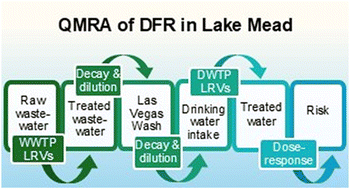
De facto reuse (DFR) refers to the incidental or unintentional incorporation of treated wastewater into natural water bodies used as a source of drinking water. Increasing recognition of this practice has highlighted a potential risk of human exposure to various chemicals and pathogens originating from wastewater. In this study, quantitative microbial risk assessment (QMRA) was used to determine the infection risks associated with norovirus, adenovirus, enterovirus, Cryptosporidium, and Giardia for DFR in Southern Nevada (i.e., Lake Mead). Scenarios included three lake levels to encompass current (329 m) and possible scenarios associated with continued drought conditions (312 m and 297 m). Starting with observed raw wastewater pathogen concentrations at local wastewater treatment plants, risks were estimated after accounting for facility-specific wastewater treatment trains, discharge-specific dilution and decay in the environmental buffers (based on hydrodynamic modeling), and drinking water treatment. Log reduction values (LRVs) for wastewater treatment were also calibrated to observed Cryptosporidium concentrations in the environment to characterize ‘gaps’ in crediting (LRVgap = 1.97). For the baseline lake level, the median cumulative risk of gastrointestinal infection from all pathogens was 10−4.59 infections per person per year, with Cryptosporidium as the primary driver of risk. Risks increased significantly for the lower lake elevations but still satisfied the annual risk benchmark of 10−4. The impacts of seasonality were also studied for norovirus, indicating increased risks during fall and spring. Overall, this study demonstrates that the current design and operation of the Southern Nevada DFR system is protective of public health with respect to enteric pathogen exposure, even if the current Colorado River Basin drought continues or worsens.
- This article is part of the themed collections: HOT articles from Environmental Science: Water Research & Technology and Recent Open Access Articles - Environmental Science: Water Research & Technology
 Please wait while we load your content...


