


 PLATFORM UPDATE:


Experimental approaches to data generation for REACH compliance of multi-walled carbon nanotubes: human health in vitro/in chemico

Abstract
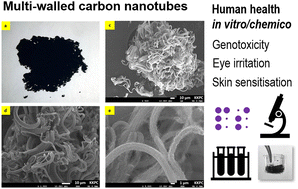
Applying regulatory-accepted, standardised test guidelines to solid, non-dispersible nanomaterials is challenging, primarily due to the difficulty of generating a homogenous exposure medium. Additional challenges arise from the physicochemical characteristics of multi-walled carbon nanotubes (MWCNTs), which are typically light and exist as entangled bundles. This study evaluated the applicability of available standardised in vitro/in chemico OECD test guidelines (TGs) for animal-free human health testing and explored potential adaptations to make them suitable for MWCNTs. Our focus was on EU-REACH data requirements related to in vitro serious eye damage/irritation, in chemico skin sensitisation, and in vitro gene mutation in mammalian cells. We assessed the applicability of OECD TG 492B, TG 442D/442E, and TG 476 for these endpoints. Our findings indicate that adequate data may only be generated if solid nanomaterials can be applied as such (as in OECD TG 492B), or if nano-specific dispersion protocols are available for an endpoint (as in genotoxicity testing), whereas significant limitations remain for skin sensitisation testing.
- This article is part of the themed collection: Recent Open Access Articles - Environmental Science: Nano
 Please wait while we load your content...


