


 PLATFORM UPDATE:


Surface charge governs polystyrene nanoplastics' influence on conjugative transfer of antibiotic resistance genes
 †ab
Sijie
Lin
*ab
†ab
Sijie
Lin
*ab
Abstract
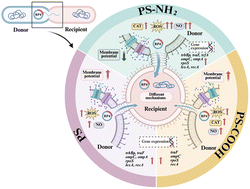
In recent years, the potential risks associated with nanoplastic (NP) pollution and the spread of antibiotic resistance genes (ARGs) have attracted considerable attention. Yet the transmission risk and potential mechanism of ARGs caused by NPs with different surface properties remain poorly understood. In this study, three types of polystyrene nanoplastics (PSNPs), i.e. PS, PS-NH2, and PS-COOH, with distinct surface charges were employed to investigate their effects on the conjugative transfer of ARGs within a microcosm system, wherein E. coli DH5α carrying the RP4 plasmid served as the donor bacterium and E. coli Rosetta (DE3) as the recipient. Our findings revealed that the impact of PSNPs on gene transfer was surface charge-dependent, underscoring the significance role of particle–membrane interactions. Carboxylated polystyrene (PS-COOH) initially promoted conjugative transfer efficiency at 1 mg L−1 but inhibited it at higher doses (10 mg L−1, 100 mg L−1). In contrast, unmodified PS exhibited a particle dose-dependent enhancement in transfer efficiency. Aminated polystyrene (PS-NH2) demonstrated a markedly amplified ARG conjugative transfer compared to the other two PSNPs, with only a minor decrease at the highest concentration of 100 mg L−1. Mechanistically, the enhancement of conjugative transfer involved the generation of reactive oxygen species (ROS) and nitric oxide (NO), alterations in membrane potential, increased membrane permeability, and modulation of conjugation-related genes. Our findings elucidate how surface characteristics drive ARG dissemination risks and provide mechanistic insights, informing strategies to mitigate antibiotic resistance in contaminated environments.
- This article is part of the themed collection: Nanoplastics in the Environment
 Please wait while we load your content...


