


 PLATFORM UPDATE:


High-content imaging reveals how tuning nanoparticle hydrophobicity impacts interactions between porous silica nanoparticles and plant biosurfaces

Abstract
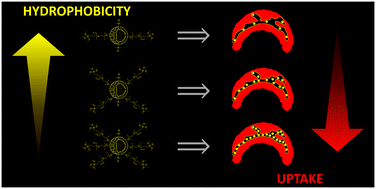
Nanoparticle surface chemistry characteristics are key factors that determine their behavior upon interaction with different organisms. In particular, electrostatic interactions between nanoparticles and plant-type organisms have been well-characterized; however, the impact of the degree of hydrophobicity remains largely unexplored. Here, ultraporous mesostructured silica nanoparticles (UMNs) were functionalized with different ratios of chlorotrimethylsilane (TMS) to 2-[methoxy(polyethyleneoxy)9–12propyl]trimethoxysilane (PEG) to systematically tune their hydrophobicity, and were subsequently used to interrogate how the degree of hydrophobicity affects nanoparticle interactions at the biointerface of the green alga, Raphidocelis subcapitata. Using high-content imaging and phenotypic profiling, the levels of UMN internalization, subcellular trafficking, and their associated phenotypic and physiological impacts were quantified. Increasing the PEG content on the surface of the UMNs, which decreased particle hydrophobicity, was found to significantly enhance levels of internalization, but did not alter translocation within the cells. Colocalization analyses indicated a strong association between UMNs and F-actin filaments after 1–24 hours of exposure, which was independent of PEG content and degree of UMN hydrophobicity, as there was no significant difference between particle types. However, after 48 hours, cells appeared to have incorporated a portion of UMNs into their cell walls while depositing the remainder into vacuolated spaces. Lastly, UMNs had a significant impact on phenotype complexity, with specific metrics including enhanced chlorophyll production and shifts in cell cycle progression; however, no growth inhibition was observed after 72 hours. Overall, using this approach, it was found that tuning the degree of UMN hydrophobicity had a significant impact on the levels of internalization. However, once inside the cells, the degree of hydrophobicity did not have a significant impact on translocation, phenotype, or physiological response as each particle type elicited similar cellular responses.
- This article is part of the themed collections: Environmental Science for a Healthier Planet and Recent Open Access Articles - Environmental Science: Nano
 Please wait while we load your content...


