


 PLATFORM UPDATE:


Release of microplastics and metals from antifouling paint during weathering in simulated cold climates

Abstract
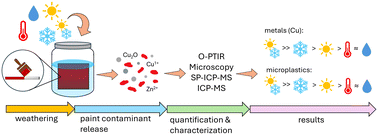
Marine antifouling paints are often overlooked as a source of microplastic pollution in the aquatic environment even though they may release microplastics and metals, including metallic nanoparticles, into the environment, especially following exposure to environmental stressors. Notably, photodegradation via sunlight and seasonal freeze-thaw cycles are impactful weathering processes that can affect boat hulls in cold climates. In this study, steel coupons coated with marine antifouling paint were submerged in water and exposed to three laboratory-controlled weathering treatments, namely, UV irradiation (UV), freeze–thaw (FT), and UV irradiation combined with freeze-thaw (UV-FT) over 42 days. Water samples were analyzed using optical photothermal infrared spectroscopy (O-PTIR), inductively coupled plasma mass spectrometry (ICP-MS), single particle ICP-MS, and microscopic imaging in order to quantify microplastics, metals and inorganic nanoparticles released from the painted surfaces. Weathering treatments released microplastics through photochemical degradation (UV) and ice abrasion. Meanwhile, for heavy metals, Cu was dominantly released in its microplastic-bound form and Zn in its dissolved form. UV-exposed paint likely underwent oxidative degradation, whereas FT exposure likely caused damage via ice abrasion, resulting in the production of paint microplastics in both cases. The IR and Raman signals showed that paint microplastics generally had high similarity to their respective painted coupons, except for the UV treatment, indicating that paint microplastics can be traced to their original source. Of the three treatments, the combined treatment of UV and FT released the highest concentrations of Cu and Zn over 42 days (49 000 ± 20 000 µg g−1 and 14 000 ± 7000 µg g−1, respectively). Cu was released at higher concentrations under weathering conditions that involved abrasion (i.e., UV-FT and FT). In contrast, more Zn was measured in the UV, HC, and CC treatments. Our findings provide a better understanding of the mechanisms leading to the release of paint-derived contaminants into the environment and further highlight the risks posed by the extensive use of marine antifouling paints.
- This article is part of the themed collections: Transformation products, mixtures, and vectors and Recent Open Access Articles - Environmental Science: Processes & Impacts
 Please wait while we load your content...


