


 PLATFORM UPDATE:


Colloidal stability and aggregation of polyethylene (PE) nanoplastics under UV weathering and PFOA contamination

Abstract
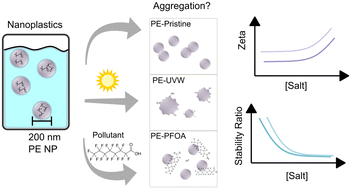
The colloidal stability of polyethylene nanoplastics (PE NPs) impacts their environmental fate. UV weathering and pollutant adsorption modify the surface of nanoparticles, alter particle–particle interactions and, in turn, modulate their colloidal stability. This study reports on the colloidal stability of 200 nm PE NPs as a function of salt concentration and surface treatment. Colloidal stability is determined for the as made particles, after UV weathering, and in the presence of perfluorooctanic acid (PFOA). Aggregation kinetics is determined using dynamic light scattering and zeta potentials. The surface properties of the PE NPs are characterized using FT-IR spectroscopy, tensiometry, and adhesion measurements. Pristine PE NPs are colloidally stable in dispersions below ∼0.1 mol L−1, but rapidly aggregate at higher salt concentrations. Environmental modifications have contrasting effects on PE NP stability. The presence of PFOA does not significantly impact the overall colloidal stability, especially at low salt concentrations, but introduces a small additional barrier for aggregation at higher salt concentrations. In contrast, UV weathering promotes particle aggregation. Our findings show that PE NPs can have some colloidal stability even in the absence of stabilizing ligands, likely due to the presence of heterogeneous surface charge caused by ion adsorption. The decrease in stability upon UV weathering is attributed to the formation of free radicals. The findings demonstrate that environmental modifications to PE NPs through pollutant adsorption or photochemical weathering can significantly alter their colloidal stability.
 Please wait while we load your content...


