


 PLATFORM UPDATE:


Sea anemones extract tin associated with polyvinyl chloride pre-production pellets
 *abc
Heileen
Hsu-Kim
d
and
*abc
Heileen
Hsu-Kim
d
and
Abstract
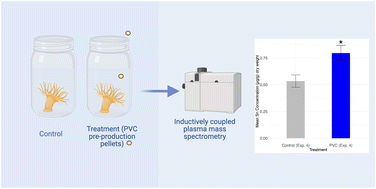
Marine animals consume microplastics; however, it remains unknown if plastic additives can be extracted from ingested microplastics. This research utilizes animal behavior experiments and analytical chemistry to determine if sea anemones consume plastic pre-production pellets and extract lead (Pb) and tin (Sn) additives from pellets. We compared the consumption of PVC pellets to shrimp-extract-flavored PVC pellets. The time from pellet ingestion to egestion (feeding retention time) averaged 7–10 hours and did not differ between untreated (83% of pellets consumed) and shrimp-flavored PVC pellets (100% of pellets consumed). Sequential feeding of the previously consumed pellets to new anemones rapidly decreased feeding retention time until pellets were no longer consumed. To determine if anemones could extract Pb and Sn additives, we ran additional feeding trials in which treatment anemones were offered one PVC pellet daily for 10 days and control anemones were not offered pellets. We quantified lead and tin in anemones, PVC pellets, seawater, and anemone food (Artemia spp.) fed to anemones using inductively coupled plasma mass spectrometry, and found that treatment anemones had significantly higher tin concentrations (0.80 ± 0.07 µg g−1) and similar amounts of lead (0.13 ± 0.01 µg g−1), compared to control anemones (0.53 ± 0.06 µg g−1 of tin and 0.15 ± 0.02 µg g−1 of lead). The increased tin concentrations in treatment anemones exceeded the amount quantified in PVC pellets, suggesting that the accumulation is attributable to other sources, at least in part. Loss of variability in tin concentrations in consumed pellets suggests that loosely associated tin may explain the observed increases in tin.
- This article is part of the themed collection: Recent Open Access Articles - Environmental Science: Processes & Impacts
 Please wait while we load your content...


