


 PLATFORM UPDATE:


Analysis of groundwater contaminant enrichment mechanisms and transport of typical pollutants in an industrial park under complex hydrogeological conditions
 *a
*a
Abstract
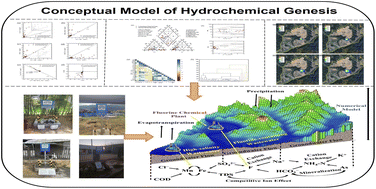
Groundwater contamination in industrial parks, characterized by its concealment and time-lag effects, has emerged as a formidable challenge for regional environmental protection. To elucidate the mechanisms underlying contaminant enrichment and to predict pollutant migration trends, this study investigated a representative industrial park in southeastern China. By integrating hydrochemical analysis, multivariate statistical methods, and numerical modeling, the research systematically explored the mechanisms of groundwater contamination under complex hydrogeochemical conditions. The results indicate that the predominant hydrochemical type in the study area is HCO3-Ca·Mg, with mixed water types such as HCO3-Na formed under industrial influence. The hydrochemical evolution is primarily governed by water–rock interactions and cation exchange. Manganese (Mn), iron (Fe), fluoride (F), and ammonium–nitrogen (NH4–N) were identified as the primary contaminants exceeding the permissible limits. The enrichment of Fe and Mn is associated with changes in ion activity, complexation reactions, and reducing conditions induced by the discharge of high-salinity wastewater. Fluoride enrichment is jointly influenced by water–rock interactions, cation exchange, and industrial discharge, while NH4–N primarily originates from the mineralization of organic matter and cation exchange processes facilitated by high-salinity wastewater. Parameters such as TDS and HCO3− were found to play a significant role in the formation of these exceeding standard contaminants. An entropy-weighted water quality index assessment revealed poor water quality in downstream areas and along riverbanks, indicating favorable conditions for contaminant accumulation. Numerical simulation, using fluoride as a representative contaminant, demonstrated its migration along the groundwater flow direction (from northwest to southeast), with the contaminant plume continuously expanding over a 20 year period, posing a long-term potential threat to downstream groundwater environments. This study elucidates the multi-source composite mechanisms and migration patterns of groundwater contamination in industrial parks, providing a scientific basis for pollution control and sustainable groundwater management.
 Please wait while we load your content...


