


 PLATFORM UPDATE:


Dynamic variability of CO2 emissions from agricultural canal-lake systems in cold and arid regions
 ab
and
Yan
Jiao
*ab
ab
and
Yan
Jiao
*ab
Abstract
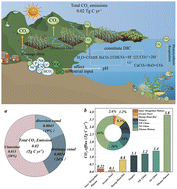
Agricultural canal-lake systems are potential hotspots for greenhouse gas (GHG) emissions; however, existing studies have largely focused on natural water bodies or single-type water bodies, with limited research on the continuum. Therefore, this study analyzed the dynamics of CO2 flux (FCO2) in the agricultural canal-Lake Ulansuhai continuum within the Hetao Irrigation District of Inner Mongolia and quantified the annual CO2 emissions (FCO2total) from agricultural canals and lakes on the Inner Mongolia Plateau. The results showed that agricultural canals were persistently supersaturated with CO2 and released it to the atmosphere, with their average FCO2 (49.43 ± 37.28 mmol per m2 per day) being significantly higher than that of the connected Lake Ulansuhai and the average level of Chinese lakes. Although the average FCO2 of Lake Ulansuhai was higher than that of major freshwater lakes in China, some areas of the lake acted as a net CO2 sink during the autumn irrigation period, revealing a dynamic shift between a carbon source and sink in cold-arid lakes. The annual CO2 emissions from agricultural canals and lakes on the Inner Mongolia Plateau were 0.0097 Tg C per year and 0.22 Tg C per year, respectively, providing key baseline data for regional carbon budgeting. This study transcends the limitations of traditional fragmented research approaches by systematically quantifying the differences in CO2 emissions between canals and lakes within the continuum and highlights the role of agricultural canal-lake systems as regional carbon emission hotspots. The findings provide a scientific basis for salinization control, eutrophication prevention, and water environment protection of the Yellow River, and also offer critical data support for regional ecological management and carbon accounting in cold and arid regions.
 Please wait while we load your content...


