


 PLATFORM UPDATE:


Sorption and desorption of per- and polyfluoroalkyl substances (PFASs) on unmodified iron oxide and silica clay minerals

Abstract
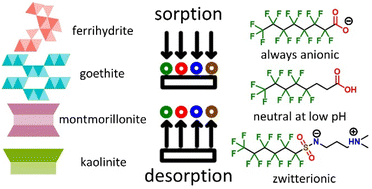
The goals of this study were to measure sorption kinetics, solid–water partitioning (log Kd values) as a function of pH, and percent desorption for a diverse set of PFASs on four highly abundant soil and aquifer minerals. We found that PFAS sorption was relatively fast on all four minerals and that overall log Kd values were higher for ferrihydrite and montmorillonite than for goethite and kaolinite, possibly driven by differences in surface area. We also found that log Kd values on ferrihydrite and goethite were dependent on pH levels and the length of the perfluoroalkyl chain. Significant differences in log Kd values between the iron oxide minerals were explained by differences in their respective point-of-zero-charge, and changes in PFAS speciation as a function of pH amplified those differences. Despite the relatively high log Kd values of the iron oxide minerals reflecting relatively high affinity for PFASs, facile desorption from the iron oxides suggests that PFAS sorption is driven by relatively weak electrostatic interactions. The log Kd values on montmorillonite and kaolinite were not significantly dependent on pH levels, but were dependent on the length of the perfluoroalkyl chain. Less facile desorption from the silica clay minerals suggests that PFAS sorption is driven by relatively strong hydrophobic and electrostatic interactions. Together, our data make practical contributions to support site characterization and remediation efforts, while also contributing key insights into the fundamental sorption processes.
- This article is part of the themed collection: Recent Open Access Articles - Environmental Science: Processes & Impacts
 Please wait while we load your content...


