


 PLATFORM UPDATE:


Image-based observation of aerosol hygroscopic growth and extinction coefficient reversal at three wavelengths, supported by Köhler theory simulations
 a
Juseon
Shin,
a
Yunki
Mun,
a
Naghmeh
Dehkhoda,
a
Sohee
Joo,
a
Dukhyeon
Kim
b
and
Youngmin
Noh
*a
a
Juseon
Shin,
a
Yunki
Mun,
a
Naghmeh
Dehkhoda,
a
Sohee
Joo,
a
Dukhyeon
Kim
b
and
Youngmin
Noh
*a
Abstract
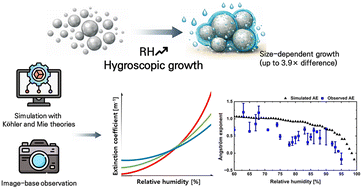
As relative humidity (RH) increases, aerosols take up water and grow. This changes their size and refractive index, affecting light scattering and absorption. Such changes can bias comparisons between remote sensing and in situ measurements. We simulated hygroscopic growth effects on extinction coefficients and the Ångström exponent (AE) at 459, 534, and 600 nm using Köhler–Mie theory. Ammonium sulfate (κ = 0.53) was used as the representative aerosol composition. The Kelvin effect suppressed the growth of sub-0.1 µm particles by a factor of ∼4 at RH > 80%. Fine-mode particles were used as a representative aerosol composition in the simulations. Fine-mode particles dominated total extinction, contributed 93.2% at 90% RH. Extinction coefficients reversed their spectral ordering near RH ∼98% in simulations and ∼92% in observations, producing negative AE. We also retrieved extinction coefficients and AE from RGB camera images during fog dissipation in Daejeon, South Korea. The observed AE became negative at high RH and returned to positive values as aerosols dried, consistent with simulations. These results show that image-based methods can capture hygroscopic growth and highlight the importance of RH-dependent corrections for reconciling remote sensing and in situ observations.
 Please wait while we load your content...


