


 PLATFORM UPDATE:


Wavelength-specific UV LED and far-UVC degradation of microplastics

Abstract
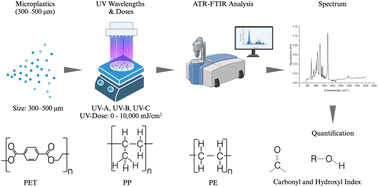
The widespread use and durability of plastics have led to significant global environmental challenges, with microplastics (MPs) recognized as contaminants of emerging concern due to their persistence, accumulation, and potential threats to human health. Photodegradation from ultraviolet (UV) radiation is a critical factor in modifying the physicochemical properties of microplastics through polymer chain scission and the incorporation of oxygen-containing functional groups. These changes can be quantitatively assessed using Fourier transform infrared (FTIR) spectroscopy through the carbonyl index and hydroxyl index. This study addressed the limited understanding of how irradiation from specific UV light-emitting diode (LED) and far-UVC wavelengths distinctly influence the degradation pathways of major polymers, including polyethylene terephthalate (PET), polypropylene (PP), and polyethylene (PE), within environmentally relevant size ranges (300–500 µm). Three additive-free microplastic polymers (PET, PP and PE) were exposed to six discrete UV LED (252, 268, 278, 290, 300, 363 nm) and far-UVC (222 nm) wavelengths, across increasing doses (500–10 000 mJ cm−2). The results demonstrated that UV-induced photo-oxidation of PET, PP, and PE is strongly wavelength-selective, polymer-specific, and frequently non-linear with UV dose. Carbonyl and hydroxyl indices provide complementary, non-interchangeable views of oxidation, while their relationship is polymer-dependent. These results provide quantitative inputs for environmental fate modeling and treatment-relevant weathering assessments of microplastics.
- This article is part of the themed collections: Transformation products, mixtures, and vectors and Recent Open Access Articles - Environmental Science: Processes & Impacts
 Please wait while we load your content...


