


 PLATFORM UPDATE:


Atmospheric oxidation of hydroxymethyl methyl α-lactone (HMML), initiated by OH radicals and Cl atoms

Abstract
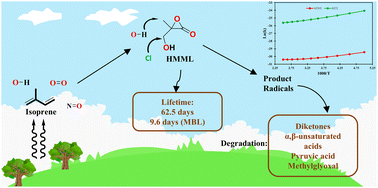
Isoprene, the most predominant biogenically emitted volatile organic compound (VOC) in the atmosphere, undergoes oxidation to yield hydroxymethyl methyl α-lactone (HMML) in the presence of NO. While the particle-phase chemistry of HMML has been explored to some extent, its gas-phase chemistry remains unexplored. In this study, we have performed an extensive computational investigation involving the thermodynamics and kinetics of the oxidation reaction of HMML in the gas phase, driven by hydroxy radicals (OH) and chlorine (Cl) atoms. The oxidation of HMML proceeds via hydrogen atom abstraction reactions, all of which are exothermic in nature. The potential energy profile diagram representing all possible reaction routes has been constructed using CCSD(T)//M06-2X/6-311++G(d,p) level of theory. The rate coefficients of all the reaction pathways were estimated using the variational transition state theory (VTST), corrected with a tunneling factor, across the 200 to 400 K temperature range at the M06-2X/6-311++G(d,p) level of theory. At 298 K, the atmospheric lifetime of HMML was determined to be 9.6 days in the marine boundary layer (MBL) and 62.5 days in the normal tropospheric conditions. Furthermore, the degradation study of the product radicals revealed various end products with much higher reactivity and shorter lifetimes, such as diketones, α, β-unsaturated carboxylic acids, formic acid, pyruvic acid, methylglyoxal, and dioxopropanoic acid.
 Please wait while we load your content...


