


 PLATFORM UPDATE:


Process-based VOC emission characteristics, environmental impact and health risk assessment in typical breweries in Beijing

Abstract
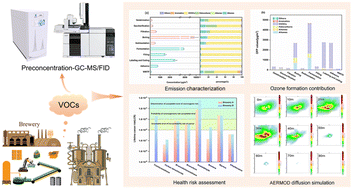
Brewing is an understudied but influential source of VOC emissions in the food manufacturing industry. In this study, we conducted a first comprehensive analysis of process-based VOC concentration characteristics, ozone formation potential (OFP), secondary organic aerosol formation potential (SOAFP) and health risks in two typical breweries in Beijing that use malted barley, hops, water, and yeast. In Brewery A, 35 to 53 distinct VOC species were detected, with total mass concentrations ranging from 148.17 ± 18.64 µg m−3 to 15 225.91 ± 1912.51 µg m−3. Brewery B demonstrated comparable patterns, with 28 to 49 species detected at concentrations between 104.49 ± 8.48 µg m−3 and 10 368.87 ± 879.47 µg m−3. Process-stage analysis identified boiling and fermentation stages as the key stages with the highest VOC concentrations, dominated by oxygenated VOCs (OVOCs) such as acetaldehyde, acetone, ethyl acetate, and 2-butanone, as well as the alkane isobutane. Atmospheric dispersion modeling (AERMOD) indicated negligible public health risks from organized stack emissions. In contrast, occupational health assessment revealed significant risks for workers from fugitive emissions, with the cumulative hazard index (HI) far exceeding the threshold. The OFP and SOAFP results, representing the secondary pollutant formation potential of the source mixtures, highlighted OVOCs and aromatics as priority control species for mitigating the secondary pollution potential. The findings demonstrate that VOC control strategies must be differentiated, with large-scale breweries prioritizing organized emissions, while small breweries urgently need to control fugitive emissions. This study aims to promote the implementation of VOC regulations and occupational health protection strategies within the brewing industry.
 Please wait while we load your content...


