


 PLATFORM UPDATE:


Enzymes involved in the manipulation of polyethylene degradation: oxidative attack by invertebrates, microorganisms and algae on microplastics
 *a
*a
Abstract
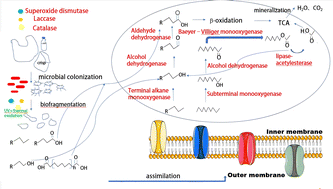
Research into polyethylene (PE) biodegradation has generated thousands of organism-level studies, yet no scalable, field-ready technology has emerged. By analysing 2931 bibliometric records alongside enzyme kinetics and ecotoxicology data, we identify three overlooked limitations. First, a reproducibility deficit, with fewer than 7% of studies reporting kinetic constants. Second, a taxonomic echo-chamber, with 65% of bacterial studies focusing on Pseudomonas despite fungi achieving consistently greater mass loss. Third, potential risks are underexplored, as oligomeric by-products are rarely quantified despite already reaching toxic thresholds in aquatic systems. To move beyond species-and-enzyme catalogs, we propose a five-layer ‘PE-degradation cube’ that quantitatively links abiotic priming, enzyme kinetics, trophic relay, reproducibility weight and by-product risk. The model pinpoints laccase-mediator systems and insect-gut consortia as the only dual-validated (bibliometrically hot and biologically efficient) pipelines ready for protein-engineering translation, offering a data-driven roadmap that previous reviews have not provided.
 Please wait while we load your content...


