


 PLATFORM UPDATE:


Occurrence, ecological impact, and exposure risk of emerging contaminant REEs in a coastal river
 *abc
*abc
Abstract
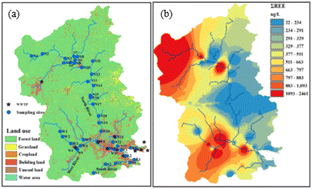
The growing demand for rare earth elements (REEs) in high-tech applications has elevated their concentrations in aquatic environments. However, comprehensive investigations into their ecological and human health risks remain limited. Forty-two river water samples from the Jiulong River basin, a representative coastal watershed, were analyzed to elucidate the occurrence, distribution, and risks of REEs. The inverse distance weighting (IDW) analysis revealed distinct spatial heterogeneity, typical fractionation between heavy and light REEs (HREEs and LREEs), and pronounced Ce and Eu anomalies. Redundancy analysis (RDA) indicated that REE concentrations were influenced by both natural geochemical processes and human activities. The key novelty of this work lies in the combined ecological risk assessment of ΣREE, highlighting the significance of mixture toxicity over individual-element evaluation. Additionally, the age-differentiated health risk assessment demonstrated that children are more susceptible to LREEs and Y exposure, although all hazard quotient (HQ) values remained below 1. Several tributaries (West river and upper North river) exhibited ΣREE risk quotient (RQ) values exceeding 1, indicating localized ecological concerns. These findings provide new insights into REE geochemical behavior and cumulative risk mechanisms in coastal rivers, establishing an integrated framework linking spatial geochemical characteristics with multi-scale risk assessments of REE contamination in coastal aquatic systems.
 Please wait while we load your content...


