


 PLATFORM UPDATE:


Shifts in soil microbiome surrounding a thermal treatment facility for hazardous waste: the hidden impact of environmentally persistent free radicals
 *a
Myron L.
Lard,
b
Robert L.
Cook,
b
Stephania A.
Cormier
c
and
Jennifer
Richmond-Bryant
d
*a
Myron L.
Lard,
b
Robert L.
Cook,
b
Stephania A.
Cormier
c
and
Jennifer
Richmond-Bryant
d
Abstract
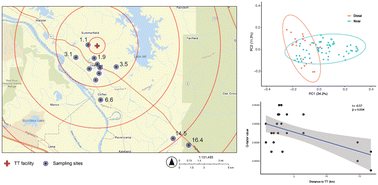
The disposal of hazardous materials from Superfund sites often involves thermal treatment (TT), generating environmentally persistent free radicals (EPFRs). While substantial evidence links EPFR exposure to negative health outcomes, its effects on the soil microbiome remain underexplored. Since the mid-1980s, a TT facility in Colfax, LA, has employed open-burn and open-detonation to process hazardous waste. In 2023, we collected soil samples from 13 residential sites within a 17-km radius of the TT facility and analyzed microbial communities and EPFR content. Our findings revealed a distinct microbial community near the TT facility (within 5-km), characterized by reduced bacterial abundance and increased fungal presence. Soil EPFR concentrations ranged from 0.81 × 10¹⁶–4.39 × 10¹⁶ spins per g with g-factor values of 2.0033–2.0040, indicating a mixture of carbon-centered radicals with adjacent oxygen and oxygen-centered radicals. Correlation analysis identified bacterial taxa, particularly Alpha-proteobacteria and Actinobacteria, positively associated with EPFR abundance. In vitro tests showed that laboratory generated EPFRs more strongly inhibited bacterial growth than fungal growth, though some bacterial isolates from the study sites exhibited resistance to EPFR exposure. The differences in microbial responses to EPFR exposure may contribute to the shifts in microbial communities near the TT facility. Our study advances the understanding of EPFR impacts on the soil microbiome and suggests potential long-term effects on environmental and community health.
- This article is part of the themed collection: Recent Open Access Articles - Environmental Science: Processes & Impacts
 Please wait while we load your content...


