


 PLATFORM UPDATE:


Supramolecular engineering-empowered safe, efficient, and stable perovskite solar cells

Abstract
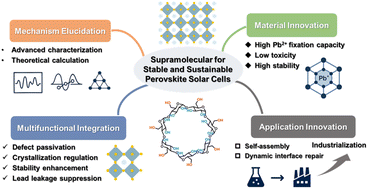
Perovskite solar cells (PSCs), an emerging photovoltaic technology, have achieved power conversion efficiencies (PCE) exceeding 27%, demonstrating significant application potential. However, their commercialization remains constrained by critical bottlenecks, including high defect-state density, uncontrollable crystallization processes, insufficient long-term stability, and lead-leakage risks. Supramolecular chemistry provides an innovative approach to addressing these challenges through non-covalent self-assembly strategies based on hydrogen bonding, π–π stacking, electrostatic interactions and van der Waals forces. This review systematically summarizes recent advances in supramolecular strategies for PSCs, focusing on defect passivation, crystallization regulation, stability enhancement, and lead-ion anchoring. It comprehensively analyzes the molecular design principles, working mechanisms, and advanced characterization techniques of representative materials. Rationally designed supramolecular systems effectively passivate surface and grain boundary defects, modulate crystallization kinetics, and enhance device stability under harsh conditions, including high temperature, high humidity, and light exposure. At the same time, they efficiently suppress lead ion migration and leakage through targeted trapping mechanisms. This review discusses the advantages and limitations of these strategies, offering theoretical insights and practical guidance for developing high-efficiency, stable, and environmentally friendly PSCs.
- This article is part of the themed collection: Celebrating Nam-Gyu Park’s 65th birthday
 Please wait while we load your content...


