


 PLATFORM UPDATE:


Hydrogen migration, surface accumulation, and nonradiative recombination in perovskite solar cells
 *a
*a
Abstract
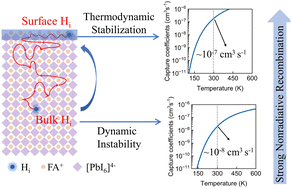
Perovskite solar cells (PSCs) have achieved efficiencies exceeding 27%, yet their performance remains limited by defect-induced nonradiative recombination. Although hydrogen interstitials (Hi) are conventionally considered as bulk defects, this study reveals the dynamic instability of Hi within the bulk lattice of FAPbI3, which drives spontaneous migration to surface sites due to thermodynamic stabilization at the interface. By combining all-atom molecular dynamics (AAMD) with nonadiabatic molecular dynamics (NAMD), we elucidate the migration pathway of Hi and its electronic implications. Surface-trapped Hi induces significant lattice distortion, resulting in the formation of deep-level defect states and a modified potential energy landscape. This reorganization reduces the electron capture barrier (ΔEn decreasing from 0.09 eV to 0.03 eV) and the hole capture barrier (ΔEp dropping from 0.24 eV to 0.17 eV), and increases carrier capture coefficients by an order of magnitude (from 10−8 cm3 s−1 to 10−7 cm3 s−1). Strengthened vibronic interactions and enhanced nonadiabatic couplings shorten the carrier lifetime from 0.8 ns (bulk Hi) to 0.1 ns (surface Hi), indicating surface-accumulated Hi is the dominant nonradiative recombination source rather than bulk Hi. These findings emphasize that interfacial hydrogen management, rather than conventional bulk passivation, is critical for designing suppression strategies to overcome performance limitations in PSCs.
- This article is part of the themed collection: EES Solar Recent HOT Articles
 Please wait while we load your content...


