


 PLATFORM UPDATE:


Interface intercalation into perovskite layer improving performance of tin perovskite solar cells
 †a
Debendra Prasad
Panda,
†a
Meng
Li,
d
Zafar
Iqbal
*c
and
Antonio
Abate
*ac
†a
Debendra Prasad
Panda,
†a
Meng
Li,
d
Zafar
Iqbal
*c
and
Antonio
Abate
*ac
Abstract
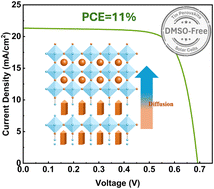
The interfaces play a critical role in determining the performance and stability of perovskite solar cells (PSCs). In this work, we introduce a buried interface engineering strategy using phenylethylammonium iodide (PEAI), which subsequently diffuses into the famadinium tin iodide (FASnI3) perovskite layer. This improves the perovskite crystallisation process, resulting in reduced lattice microstrain and better film microstructure. Consequently, the nonradiative recombination is supressed, suggesting an improved charge carrier dynamics. This approach is particularly effective for tin perovskites processed without dimethyl sulfoxide (DMSO), where controlling crystallisation remains a major challenge. DMSO-free tin-PSC devices fabricated using this strategy deliver a power conversion efficiency exceeding 11%, retaining 90% of their initial efficiency after 3500 hours of storage. These findings underscore the critical role of buried interface engineering in regulating bulk properties, marking a significant advancement in the development of efficient and stable tin-PSCs.
 Please wait while we load your content...


