


 PLATFORM UPDATE:


Electrochemical direct air capture with intermittent renewable energy: techno-economic insights from solar-driven electrodialysis systems
 *b
and
*b
and
Abstract
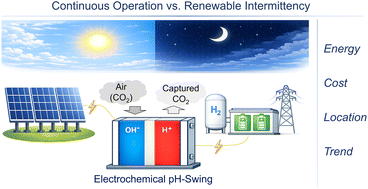
Electrochemical direct air capture (DAC) driven by renewable electricity offers a fully electrified pathway for scalable carbon removal, yet its integration with intermittent renewable power and the resulting system-level constraints remain poorly understood. Here we present a comprehensive techno-economic assessment of bipolar membrane electrodialysis (BPMED)-based DAC systems powered by solar electricity, explicitly accounting for diurnal and seasonal variability, energy storage requirements, and operational flexibility. Using a physics-based, time-resolved modelling framework with real solar irradiance data, we evaluate three representative configurations: battery storage, integrated hydrogen production, and decoupled hydrogen generation. While battery storage achieves the lowest specific energy consumption (430 kJ per mol-CO2), hydrogen-based configurations are more cost-effective for long-duration storage under strict off-grid operation. Flexible BPMED load reduces seasonal storage demand, yielding a minimum DAC cost of 2163 $ per t-CO2. We further show that electricity supply flexibility, enabled by limited grid assistance, defines a practical lower bound on system-level electricity costs, enabling LCOEs below 100 $ MWh−1 and DAC costs below 1000 $ per t-CO2. Under favorable future scenarios (50 $ MWh−1 electricity and 100 $ m−2 membrane cost), BPMED-based DAC costs are projected to decrease to 330 $ per t-CO2. Beyond BPMED-specific results, this work identifies generalizable constraints and design principles applicable to electrochemical DAC technologies under renewable electricity supply.
- This article is part of the themed collection: EES Solar Recent HOT Articles
 Please wait while we load your content...


