


 PLATFORM UPDATE:


Organic solar cells: evolution of morphological and electronic properties as a function of steric hindrance from the acceptor side groups

Abstract
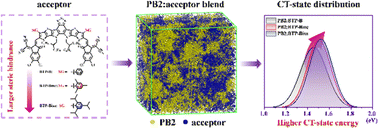
High non-radiative recombination losses are currently limiting the efficiency of organic solar cells (OSCs). Attaching sterically bulky side groups to acceptors is a strategy that has been recently developed to reduce such losses. However, it remains unclear how these side groups impact the nanoscale morphology and electronic properties in neat acceptor films and donor:acceptor blends as a function of their steric hindrance due to the experimental challenges in accessing these aspects, which hinders the further development of more efficient acceptors. Here, we characterize these aspects using a tight combination of all-atom molecular dynamics simulations and long-range corrected density functional theory calculations. As representative systems, we select PB2 as the polymer donor and three Y6-core-based acceptors functionalized with benzene, trimethylbenzene, and triisopropylbenzene groups (denoted as BTP-B, BTP-Bme, and BTP-Biso, respectively). As steric hindrance increases, excessive acceptor aggregation is suppressed; acceptor_acceptor packing distances increase, reducing electronic couplings and intermolecular electron-transfer rates (ke). Interestingly, the PB2_PB2 packing distances also increase; however, the packing pattern changes, enhancing electronic couplings and the interchain hole-transfer rate (kh). This results in a more balanced ke/kh ratio in the PB2:BTP-Bme blend. Additionally, the PB2_acceptor packing distances increase, which elevates the charge-transfer states and decreases electronic couplings between these states and the ground state, thereby lowering the corresponding non-radiative recombination rates and losses. Together, these yield the lowest non-radiative recombination losses in the PB2:BTP-Bme-based OSCs. Overall, we present a comprehensive picture that describes how such a strategy improves the nanoscale morphology and electronic properties of OSCs, which can be beneficial for designing highly efficient acceptors.
- This article is part of the themed collection: EES Solar Recent HOT Articles
 Please wait while we load your content...


