


 PLATFORM UPDATE:


HTL- & ETL-free metal–semiconductor–metal structure organic solar cells
 b
Muhammad
Jahandar,
e
Jin Young
Kim,
df
Young S.
Park,
b
BongSoo
Kim,
*bfh
Dong
Chan Lim
*e
and
Shinuk
Cho
*a
b
Muhammad
Jahandar,
e
Jin Young
Kim,
df
Young S.
Park,
b
BongSoo
Kim,
*bfh
Dong
Chan Lim
*e
and
Shinuk
Cho
*a
Abstract
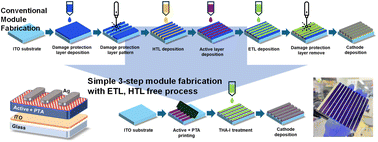
In high-performance organic solar cells (OSCs), the electron transport layer (ETL) and hole transport layer (HTL) are essential for facilitating the efficient transfer of electrons and holes generated in the photoactive layer to the respective electrodes. However, challenges associated with the ETL and HTL remain critical issues in OSC research. In this work, our study presents a novel fabrication approach that eliminates the need for the ETL and HTL, achieving structural simplification while maintaining high performance through simple interfacial treatments between the active layer and electrodes. To implement a Metal–Semiconductor–Metal (MSM) structure without the ETL and HTL, we explored three different approaches. The first strategy (Type-I) used a self-assembled monolayer at the anode interface and a salt for cathode interface modification. The second strategy (Type-II) introduced two different salts at the anode and cathode interfaces, respectively. The third strategy (Type-III) involved simultaneously coating a mixture of hole-transport-capable molecules and active materials to spontaneously form a hole extraction interface, while applying amine salts to the electron-extracting cathode interface. All three approaches successfully achieved OSCs with an MSM structure, yielding performances exceeding 18%, comparable to conventional devices with the ETL and HTL. Our findings offer a substantial simplification in the fabrication process of organic photovoltaic cells, representing a significant advancement toward their commercialization.
- This article is part of the themed collection: EES Solar Recent HOT Articles
 Please wait while we load your content...


