


 PLATFORM UPDATE:


Porphyrin bridged SnO2/active layer for efficient and stable inverted organic solar cells

Abstract
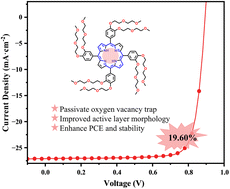
Interface modification of the electron transport layers (ETLs) is crucial to simultaneously enhance the efficiency and stability of inverted organic solar cells. In this work, we design and synthesize a porphyrin derivative with oligo ethylene glycol side chains (TPP-OEG) as a multifunctional interfacial modifier of the SnO2 ETL. TPP-OEG effectively passivates the surface defects on SnO2 and lowers its work function. Meanwhile, the oligo ethylene glycol side chains improve the interfacial compatibility with the active layer and regulate the film formation kinetics, improving molecular crystallization and interfacial ordering. Through this dual role, TPP-OEG acts as a molecular bridge that electronically and structurally couples SnO2 with the active layer, enabling more balanced charge extraction, reduced recombination, and improved crystalline ordering. As a result, the inverted devices with TPP-OEG-modified SnO2 ETLs achieve a champion power conversion efficiency of 19.60% based on the PM6:L8-BO:BTP-eC9 system, representing the highest reported efficiency for single-junction inverted OSCs to date. Moreover, the TPP-OEG devices show remarkably improved thermal and storage stability compared with the devices employing bare SnO2 or TPP-modified SnO2 ETLs. This study demonstrates that porphyrins with suitable tailored side chains offer a promising strategy for interface engineering in high-performance and stable organic photovoltaics.
- This article is part of the themed collection: EES Solar Recent HOT Articles
 Please wait while we load your content...


