


 PLATFORM UPDATE:


Progress in perovskite indoor photovoltaics

Abstract
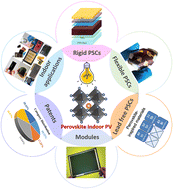
The rapid growth of the internet of things (IoT) and artificial intelligence (AI) has created strong demand for efficient indoor photovoltaics (IPVs). Photovoltaic materials with bandgaps of 1.8–2.0 eV can theoretically achieve power conversion efficiencies (PCEs) of 53–56% under artificial light sources. Among competing technologies, perovskite solar cells (PSCs) stand out due to their low-cost fabrication, adjustable bandgap, mechanical flexibility, and outstanding performance under low-light conditions. State-of-the-art PSCs have achieved experimentally-measured indoor power conversion efficiencies exceeding 45% (42%) on rigid substrates and 42% (35%) on flexible substrates under 1000 lx (200 lx) indoor light. Even though meaningful comparison across studies remains challenging due to the lack of standardized indoor photovoltaic characterization protocols, these advances have attracted substantial industrial interest, with emerging companies actively developing PSC-based self-powered IoT devices. To accelerate industrialization, a comprehensive understanding of PSC development, challenges, and opportunities is essential. This review systematically examines six key areas: rigid devices, flexible devices, lead-free PSCs, perovskite modules, applications in self-powered indoor devices, and related patents. We summarize recent progress, highlight current limitations, and discuss potential strategies, while also creating visual maps of the scientific landscape in this arena, aiming to provide an integrated perspective on the future of perovskite IPV.
 Please wait while we load your content...


