


 PLATFORM UPDATE:


How nanotextured interfaces influence the electronics in perovskite solar cells
 a
Jacob
Relle,
bc
Thomas
Kirchartz,
de
Patrick
Jaap,
f
Jürgen
Fuhrmann,
f
Sven
Burger,
cg
Christiane
Becker,
*bh
Klaus
Jäger
*bc
and
Patricio
Farrell
*a
a
Jacob
Relle,
bc
Thomas
Kirchartz,
de
Patrick
Jaap,
f
Jürgen
Fuhrmann,
f
Sven
Burger,
cg
Christiane
Becker,
*bh
Klaus
Jäger
*bc
and
Patricio
Farrell
*a
Abstract
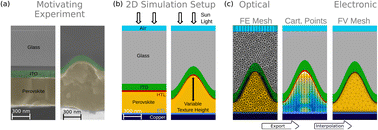
Perovskite solar cells have reached power conversion efficiencies that rival those of established silicon photovoltaics. Nanotextures in perovskite solar cells scatter the incident light, thereby improving optical absorption. In addition, experiments show that nanotextures impact electronic performance, although the underlying mechanisms remain unclear. This study investigates the underlying theoretical reasons by combining multi-dimensional optical and charge-transport simulations for a single-junction perovskite solar cell. Our numerical results reveal that texturing redistributes the electric field, influencing carrier accumulation and recombination dynamics. We find that moderate texturing heights (≤300 nm) always increase the power conversion efficiency, regardless of surface recombination velocities. Our study also clarifies why experiments have reported that texturing both increased and reduced open-circuit voltages in perovskite solar cells: this behaviour originates from variations in surface recombination at the untextured electron transport layer. In contrast, surface recombination at the textured hole transport layer strongly affects the short-circuit current density, with lower recombination rates keeping it closer to the optical ideal. These findings provide new insights into the opto-electronic advantages of texturing and offer guidance for the design of next-generation textured perovskite-based solar cells, light emitting diodes, and photodetectors.
 Please wait while we load your content...


