


 PLATFORM UPDATE:


Unraveling bulk degradation mechanisms of wide-bandgap perovskite absorbers for tandem applications

Abstract
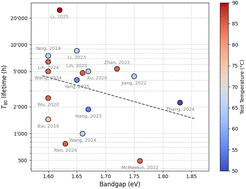
Wide-bandgap (WBG) perovskite absorbers play a pivotal role in enabling high-efficiency tandem solar cells; yet, their long-term operational stability remains a significant hurdle to commercialization. Although interface engineering has led to promising progress, these improvements have not yet translated into the level of stability required for market readiness. Recent studies increasingly highlight the intrinsic instability of the perovskite bulk as a key limiting factor. This review examines the underlying mechanisms that compromise bulk stability in WBG perovskites (1.65–1.8 eV), covering both mixed-cation mixed-halide absorbers and fully inorganic systems such as CsPbI3. Particular attention is given to the intrinsic factors that compromise the long-term stability of WBG perovskites, including compositional inhomogeneities, crystallization-driven disorder, insufficient crystallinity and texture, nanoscale phase impurities, and intrinsic phase-instability phenomena. Mixed-cation mixed-halide formulations, widely used to access tandem-relevant bandgaps, frequently exhibit spatially uneven elemental distributions and light- or thermally induced halide segregation, both of which introduce structural and electronic disorder. In parallel, inorganic WBG absorbers such as CsPbI3 are predominantly limited by their strong propensity for converting to non-perovskite phases. In both material families, the crystallization pathway critically dictates the spatial distribution of components and the incorporation of defects. The resulting heterogeneities, together with nanoscale impurities and secondary phases, serve as initiation sites for absorber degradation under operational conditions. This review discusses emerging strategies aimed at overcoming these challenges, including compositional engineering, crystallization control, and targeted passivation. By addressing the root causes of bulk instability, this work outlines guidance toward achieving the long-term stability required for WBG perovskites in tandem photovoltaic technologies.
- This article is part of the themed collection: EES Solar 2026 Review Articles
 Please wait while we load your content...


