


 PLATFORM UPDATE:


Effect of RbF post-deposition treatment on open-circuit voltage in wide-gap (Ag,Cu)(In,Ga)Se2 solar cells
 *a
Saeed
Bayat,
b
Ana
Kanevce,
a
Wolfram
Hempel,
a
Stefan
Paetel,
a
Susanne
Siebentritt
b
and
Wolfram
Witte
a
*a
Saeed
Bayat,
b
Ana
Kanevce,
a
Wolfram
Hempel,
a
Stefan
Paetel,
a
Susanne
Siebentritt
b
and
Wolfram
Witte
a
Abstract
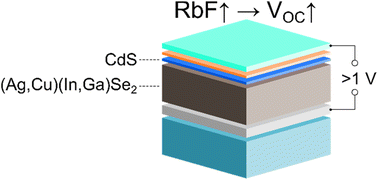
The compositional flexibility of the compound semiconductor (Ag,Cu)(In,Ga)Se2 (ACIGS) allows fabricating thin-film solar cells with band gaps around 1.5 eV and above. These cells are well suited as top cells in tandem devices, for example together with silicon bottom cells, but also find use in photoelectrochemical energy conversion. However, current wide-gap ACIGS solar cells suffer from large open-circuit voltage losses, severely limiting their overall performance. Using an established inline ACIGS process with a standardized cell fabrication workflow, we explore different CdS buffer thicknesses, grown by chemical bath deposition on wide-gap ACIGS cells with a band gap ∼1.5 eV. In addition, we systematically increase the RbF amount provided in post-deposition treatments. Quantum efficiency measurements, time-resolved and absolute steady-state photoluminescence help to understand the dependence of device performance on absorber composition and CdS buffer thickness. We observe a strong increase of the open-circuit voltage with RbF provided during post-deposition and concomitantly on charge carrier density as derived from capacitance–voltage measurements. Photoluminescence quantum yield likewise increases with increasing RbF amounts, leading to an increase in Quasi-Fermi level splitting. The highest charge carrier density is found in a cell with an open-circuit voltage exceeding 1000 mV at a an ACIGS band gap of 1.55 eV.
 Please wait while we load your content...


