


 PLATFORM UPDATE:


Bandgap-tunable transparent perovskite solar cells for 4T Si/perovskite tandem photovoltaics with PCE > 30% via rational interface management
 †a
Tiankai
Zhang,
†b
Ananta
Paul,
c
M. M.
Anas,
d
Karthik
Raitani,
d
Manas
Misra,
e
Subir
Manna,
e
Vishnu
Kumar,
e
Sudhanshu
Mallick,
c
K. R.
Balasubramaniam,
a
Pradeep R.
Nair,
*d
Feng
Gao
*b
and
Dinesh
Kabra
*e
†a
Tiankai
Zhang,
†b
Ananta
Paul,
c
M. M.
Anas,
d
Karthik
Raitani,
d
Manas
Misra,
e
Subir
Manna,
e
Vishnu
Kumar,
e
Sudhanshu
Mallick,
c
K. R.
Balasubramaniam,
a
Pradeep R.
Nair,
*d
Feng
Gao
*b
and
Dinesh
Kabra
*e
Abstract
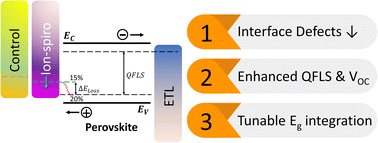
Silicon/perovskite tandem solar cells are predominantly recognized as a promising next-generation photovoltaic technology. The precise control of interfacial defects with appropriate energy level alignment between charge transport layers (CTLs) and the perovskite absorber is a crucial factor influencing the overall photovoltaic performance of perovskite solar cells (PSCs). This study investigates the substitution of conventional lithium bis(trifluoromethane)sulfonimide (LiTFSI)- and 4-tert-butylpyridine (t-BP)-doped spiro-MeOTAD with a post-oxidation-free, ion-modulated spiro-MeOTAD hole transport layer (HTL) for tunable bandgap transparent PSCs. The incorporation of 4-tert-butyl-1-methylpyridinium bis(trifluoromethanesulfonyl)imide (TBMP+TFSI−) enables reduced Shockley-Read-Hall (SRH) recombination and controlled work function tuning, leading to enhanced quasi-Fermi level splitting (QFLS). Three different perovskite compositions are employed, with perovskite 2 (1.61 eV) demonstrating optimal performance with both control and ion-modulated spiro-MeOTAD, resulting in minimal photovoltaic performance deviations. In contrast, perovskite 1 (1.52 eV) and perovskite 3 (1.72 eV) exhibit suboptimal optoelectronic properties with the control HTL. The TBMP+TFSI−-doped spiro-MeOTAD HTL enhances the photoluminescence quantum efficiency (PLQY) and carrier lifetime by reducing interfacial defects, improving the open circuit voltage (VOC) and fill factor (FF), in agreement with our detailed simulation results. Integrating the optimized PSCs with an n-type tunnel oxide passivated contact (n-TOPCon) silicon (Si) solar cell in a 4-terminal (4T) tandem configuration achieves a power conversion efficiency (PCE) of 30.2%, highlighting the potential of ion-modulated spiro-MeOTAD for efficient and stable tandem solar cells.
 Please wait while we load your content...


