


 PLATFORM UPDATE:


Exploiting perylene- and naphthalene-based planar aromatic n-type dopants for SWCNT cathodes in inverted perovskite solar cells

Abstract
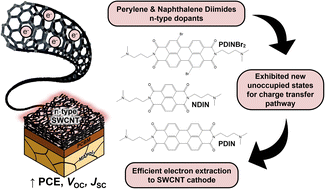
Inverted perovskite solar cells (PSCs) with planar p–i–n architecture offer enhanced stability and tandem compatibility. However, their performance remains constrained by the instability and rigidity of conventional metal cathodes. Single-walled carbon nanotubes (SWCNTs) have emerged as promising alternatives owing to their conductivity, flexibility, and processability. However, their intrinsic p-type nature and low work function relative to the perovskite conduction band limit their applicability as cathodes in PSCs. To overcome these challenges, we employed a molecular doping strategy using planar aromatic n-type dopants, to modulate the electronic properties of SWCNTs. Three π-conjugated imide-based molecules N,N′-bis[3-(dimethylamino)propyl]perylene-3,4,9,10-tetracarboxylic diimide (PDIN), its bay-substituted dibromo derivative, N,N′-bis[3-(dimethylamino)-propyl]-1,7-dibromoperylene-3,4,9,10-tetracarboxyl diimide (PDINBr2), and the naphthalene analogue N,N′-bis[3-(dimethylamino)propyl]naphthalene-1,4,5,8-tetracarboxylic diimide (NDIN) were selected for their tunable LUMO levels, high intrinsic conductivity, and strong π–π interactions with SWCNTs. Density functional theory (DFT) calculations reveal that PDINBr2 doped SWCNTs exhibited the formation of new unoccupied states favorable for efficient charge transfer from the electron transporting layer (ETL), supported by stable adsorption and strong orbital overlap. The doped SWCNTs were integrated as cathodes in inverted PSCs, achieving power conversion efficiencies up to 10.12%. Device characterization confirmed improved electron extraction, extended carrier lifetime, and suppressed interfacial recombination. Moreover, perylene-based dopants contributed to enhanced device stability, with unencapsulated cells retaining 80% of their initial efficiency after 800 hours under ambient light and 25% relative humidity. This work demonstrates a new strategy to use planar aromatic molecular dopants for enabling SWCNTs as cathodes and provides a pathway for scalable, metal-free electrodes in next-generation PSCs.
- This article is part of the themed collection: Perovskite solar cells
 Please wait while we load your content...


