


 PLATFORM UPDATE:


The role of terminal functional groups in molecular passivation of the perovskite/hole-selective layer interface
 *a
Thomas W.
Gries,
b
G. Krishnamurthy
Grandhi,
c
Emil
Rosqvist,
d
Rustem
Nizamov,
a
Sari
Granroth,
e
Paola
Vivo,
c
Ronald
Österbacka,
f
Jan-Henrik
Smått,
d
Antonio
Abate
b
and
Kati
Miettunen
a
*a
Thomas W.
Gries,
b
G. Krishnamurthy
Grandhi,
c
Emil
Rosqvist,
d
Rustem
Nizamov,
a
Sari
Granroth,
e
Paola
Vivo,
c
Ronald
Österbacka,
f
Jan-Henrik
Smått,
d
Antonio
Abate
b
and
Kati
Miettunen
a
Abstract
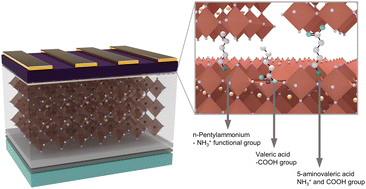
The objective of this study is to investigate how terminal functional groups in passivating agents influence the optoelectronic properties and photovoltaic performance of perovskite solar cells. Engineering the perovskite/hole-selective layer interface is critical for effective defect passivation, reduced interfacial recombination, improved charge extraction, optimized energy level alignment, and overall enhancement of device performance. While various molecular strategies have been proposed, the role of specific functional groups in passivating interfacial defects remains poorly understood. Here, a comparative investigation is conducted on three molecules with identical five-carbon backbones but distinct functionalities ammonium (n-pentylammonium iodide), carboxylic acid (valeric acid), and a bifunctional ammonium–carboxylic acid (5-ammonium valeric acid iodide) as passivating agents in perovskite/hole-selective layer interface. Optoelectronic characterization studies including photoluminescence, surface photovoltage, and conductive atomic force microscopy reveal distinct functional group-dependent variations in trap passivation, carrier dynamics, and interfacial conductivity. Devices based on surface-treated perovskites with single-functional group agents exhibit improved open-circuit voltage (VOC) and fill factor (FF), confirming efficient trap suppression and charge extraction. In contrast, the bifunctional molecule, despite effective trap passivation, limits the hole extraction. This work highlights the critical role of molecular functionality in determining interfacial interactions and charge transfer, offering a strategic pathway for interface engineering in perovskite photovoltaics.
- This article is part of the themed collection: Perovskite solar cells
 Please wait while we load your content...


