


 PLATFORM UPDATE:


Semitransparent color tunable perovskite solar cells with 3D pillar structure
 a
Lioz
Etgar
*a
a
Lioz
Etgar
*a
Abstract
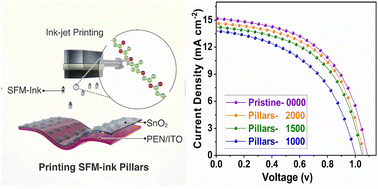
Semi-transparent, flexible, and coloured solar cells are highly attractive for building-integrated photovoltaics (BIPV) and indoor PV applications. Here, we report the fabrication of low-temperature processed, flexible, semi-transparent, and colour-tunable perovskite solar cells. Optical transparency is achieved through 3D-printed micro-patterned pillars, using an eco-friendly, solvent-free monomer. Colour tunability is controlled by the thickness of the top transparent electrode, designed as a dielectric–metal–dielectric stack. These semi-transparent devices selectively reflect light at specific wavelengths (perceived as colour), enabling retrofitting for existing windows. The fabrication process integrates plasma-assisted low-temperature deposition of a charge transport layer, inkjet printing of 3D pillars, and coloured transparent contact without altering the perovskite composition. The flexible semi-transparent devices demonstrated a power conversion efficiency of 9.2%, an average visible transparency of 35%, and excellent bending stability. This method offers a general strategy for realizing semi-transparent perovskite solar cells with diverse compositions, without requiring bandgap modification.
- This article is part of the themed collection: Perovskite solar cells
 Please wait while we load your content...


