


 PLATFORM UPDATE:


Balancing driving force, charge transport, and non-radiative recombination in organic solar cells with non-fused ring acceptors
 †‡abcd
Manasi
Pranav,
†e
De-Li
Ma,
†a
Bernhard
Siegmund,
bcd
Melissa
Van Landeghem,
bcd
Hongzheng
Chen,
a
Chang-Zhi
Li,
*a
Dieter
Neher
*e
and
Koen
Vandewal
*bcd
†‡abcd
Manasi
Pranav,
†e
De-Li
Ma,
†a
Bernhard
Siegmund,
bcd
Melissa
Van Landeghem,
bcd
Hongzheng
Chen,
a
Chang-Zhi
Li,
*a
Dieter
Neher
*e
and
Koen
Vandewal
*bcd
Abstract
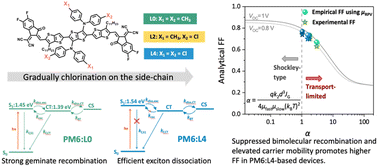
The design of low-cost, stable, and high-efficiency non-fullerene acceptors requires a deeper understanding of the impact of the molecular structure on photovoltaic performance. In this study, we investigate the influence of gradual side-chain modifications of non-fused ring acceptors. The transition from non- (L0) to partially (L2) and fully chlorinated (L4) side chains enhances the molecular self-assembly, condenses the intermolecular packing, and balances the electron and hole mobility. Additionally, we observe lower bimolecular recombination coefficients and field-independent exciton dissociation upon gradual chlorination of the side chains, which improves the fill factor of the devices. However, the accompanying higher non-radiative voltage loss restricts the performance of the fully chlorinated L4 systems. Thus, the blend PM6:L2 balances efficient exciton dissociation with reduced non-radiative recombination, yielding the highest efficiency. This study emphasizes the pivotal role of side-chain halogenation in fine-tuning molecular packing and charge dynamics, offering guidelines for the next generation high efficiency photovoltaic materials.
 Please wait while we load your content...


