


 PLATFORM UPDATE:


Photovoltaic drives 100× carbon reduction and albedo-driven cooling exceeding forestation in climate mitigation
 a
a
Abstract
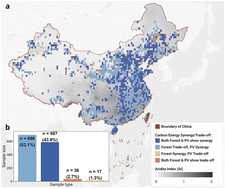
Large-scale photovoltaic (PV) systems and anthropogenic forestation are increasingly used to fight climate change. However, their distinct mechanisms regarding albedo and carbon management pose a challenge to quantify their climate mitigation effectiveness, a gap rooted in systemic neglect of PV's albedo-mediated synergy. Our 0.5° × 0.5° grid-cell region analysis (n = 1465) demonstrates PV's dual advantage, with achieving synergy between carbon gains and Earth's surface energy balance in 96% of regions through 100-fold higher emission reductions than CO2 absorption of forestation (15 vs. 0.09 kgC per m2 per year) and albedo-driven solar radiative cooling that amplifies with carbon gains (Δα/ΔC = 0.008 ± 0.0007). Conversely, anthropogenic forestation requires tradeoff in 54.8% of cases, where albedo decline with carbon gains (Δα/ΔC = −0.004 ± 0.0007) generates solar radiative warming equivalent to six times of their CO2 absorption benefit. Mechanistically, a change in PV's effective albedo (accounting for PV solar-to-electricity conversion) relative to the original land steeply responds to the aridity index (slope = −0.007 vs. forestation's −0.001), enabling >0.5 synergy probability in wider ranges of original surface albedo regions (α < 0.25) versus forestation's limited climate mitigation efficacy in humid regions (aridity index >1.47, synergy probability <0.5). Our synergy probability modeling framework emphasizes the previously underappreciated carbon gains and regulating solar radiation energy within PV systems, helping formulate more effective climate mitigation strategies by optimizing the spatial arrangement of PV plants in actual environmental conditions.
- This article is part of the themed collection: EES Solar Recent HOT Articles
 Please wait while we load your content...


