Hole-transport layer-dependent degradation mechanisms in perovskite solar modules

Abstract

It is imperative to understand how the design of perovskite solar modules (PSMs) affects their degradation mechanisms and byproducts under environmental stressors to enable their long-term reliability. This work reports on the impact of the hole-transport layer (HTL) on thermal cyclability and degradation mechanisms of p–i–n PSMs by comparing 3 HTLs: NiOx, MeO-2PACz (a self-assembled monolayer), and a bilayer HTL of MeO-2PACz on NiOx. We observe surprising thermal cyclability from a performance standpoint despite generating clear degradation products. We find that without a fully dense HTL, seemingly insignificant moisture/oxygen ingress through the edge of the PSMs can lead to rapid destabilization of the metal halide perovskite (MHP) layer due to reactions between MHP degradation byproducts and the indium-tin oxide layer. We also show that illumination-induced cation phase segregation is dependent on the illumination of an inactive area (regions of the substrate uncovered by the rear electrode). As such, we find that a dense interface between the MHP and ITO is necessary for chemically robust PSMs and highlight criteria for testing field-relevant configurations in lab-scale architectures.
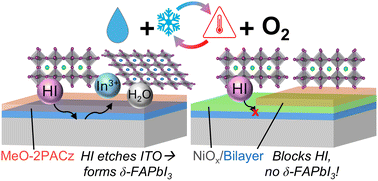
Graphical abstract: Hole-transport layer-dependent degradation mechanisms in perovskite solar modules

Supplementary files

Transparent peer review

To support increased transparency, we offer authors the option to publish the peer review history alongside their article.

View this article’s peer review history

Article information

Article type
Paper
Submitted
29 May 2025
Accepted
09 Nov 2025
First published
17 Nov 2025
This article is Open Access
Creative Commons BY-NC license

EES Sol., 2026, Advance Article

Hole-transport layer-dependent degradation mechanisms in perovskite solar modules

M. Casareto, S. Penukula, W. Nie and N. Rolston, EES Sol., 2026, Advance Article , DOI: 10.1039/D5EL00083A

This article is licensed under a Creative Commons Attribution-NonCommercial 3.0 Unported Licence. You can use material from this article in other publications, without requesting further permission from the RSC, provided that the correct acknowledgement is given and it is not used for commercial purposes.

To request permission to reproduce material from this article in a commercial publication, please go to the Copyright Clearance Center request page.

If you are an author contributing to an RSC publication, you do not need to request permission provided correct acknowledgement is given.

If you are the author of this article, you do not need to request permission to reproduce figures and diagrams provided correct acknowledgement is given. If you want to reproduce the whole article in a third-party commercial publication (excluding your thesis/dissertation for which permission is not required) please go to the Copyright Clearance Center request page.

Read more about how to correctly acknowledge RSC content.

Social activity

Spotlight

Advertisements