


 PLATFORM UPDATE:


Activating sp hybridization of zinc iodide via πsp–p bonding donation enables Ah-level seawater-based wearable zinc–iodine pouch cells

Abstract
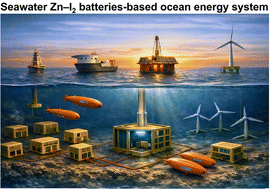
Seawater-based zinc–iodine batteries are promising for marine energy storage, offshore renewable integration, and deep-sea robot power supply owing to their intrinsic safety, low cost and abundant electrolyte resources. Their practical deployment, however, is limited by zinc anode instability in complex seawater electrolytes, which accelerates corrosion and dendrite growth, and by iodine cathodes with sluggish kinetics and severe polyiodide migration, resulting in poor reversibility. Here, we develop a multifunctional catalytic strategy that simultaneously stabilizes the zinc–electrolyte interface via passivation protection and activates iodine redox chemistry through hybridized πsp–p orbital interactions, enabling efficient zinc–iodine conversion while suppressing parasitic polyiodide reactions. Consequently, the flexible modified cells retain a stable capacity of 130 mAh g−1 over 25 000 cycles and deliver Ah-level capacities of 1.01 Ah and 0.41 Ah with 100 and 2700 cycles, respectively, while maintaining mechanical robustness and stable operation from 0 to 25 °C, underscoring their potential for application in practical seawater-based batteries toward offshore energy storage.
 Please wait while we load your content...


