


 PLATFORM UPDATE:


Lattice reconstruction strategy for fast-charging plateau-type hard carbon anodes in ultra-long-life sodium-ion batteries

Abstract
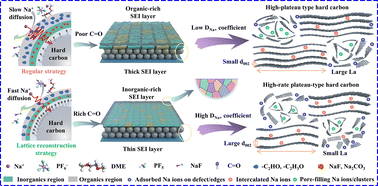
Hard carbon, a promising sodium-ion battery anode due to its abundance, specific capacity, and low operating voltage, still faces challenges in achieving fast-charging plateau-type performance with long cycles—critical for high-energy-density sodium-ion batteries. Herein, considering that hard carbon comprises a unique superposition of amorphous and crystalline domains, we reconstructed its graphitic domains to achieve a large interlayer distance, reduced average crystallite width, and inorganic-rich solid electrolyte interphase chemistry through a lattice reconstruction strategy that decouples defect passivation from graphitization via a brief high-temperature reconstruction dwell. This strategy selectively removes the most reactive defects without excessive graphitization, creates a stable thin solid electrolyte interphase film to accelerate sodium ion transport at the interface, and preserves sufficient closed pore structures to support large plateau capacity and enhanced bulk diffusion. Benefiting from our strategy, we achieve a high-performance plateau-type hard carbon anode of 324 mAh g−1 and an initial Coulombic efficiency of 89.5% with fast-charging capacity of 182 mAh g−1 even at 5.0 A g−1 along with excellent capacity retention of 79.1% after 10 000 cycles at 2.0 A g−1, exceeding reported values for both Joule-heating and conventional annealing methods. Therefore, this work provides new insights into balancing interlayer distance and crystallite width for next-generation fast-charging hard carbon anodes.
 Please wait while we load your content...


