


 PLATFORM UPDATE:


Beyond electronic effects: hydrogen-bond engineering via N-mediated microenvironment control for accelerated oxygen electroreduction

Abstract
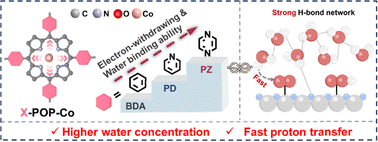
The pursuit of high-performance single-atom catalysts (SACs) for the oxygen reduction reaction (ORR) is overwhelmingly dominated by the regulation of the electronic structure of active sites, whereas the pivotal impact of the catalyst–electrolyte interface and the corresponding water structure has received insufficient attention. Herein, we develop a molecularly precise platform based on cobalt porphyrin polymers with atomically precise N gradation at the linkers. This pyrolysis-free strategy simultaneously tailors the electronic structure of Co–N4 sites via N atoms at the linkers while leveraging their strong electronegativity to anchor and restructure interfacial water molecules. Through integrated in situ spectroscopic analysis, ab initio molecular dynamics simulations, and extensive experimental evidence, we demonstrate that N-rich linkers optimize the interfacial hydrogen-bond networks, facilitating efficient proton transport via the Grotthuss mechanism and significantly reducing the energy barrier of the rate-determining proton-coupled electron transfer step (formation of *OOH). Consequently, the pyrazine-linked catalyst (PZ–POP–Co) exhibits a remarkable increase of 80 mV in half-wave potential towards the ORR and a 3-fold higher peak power density in zinc–air batteries compared to its N-free linker counterpart. This work identifies interfacial hydrogen-bond network engineering as a crucial and hitherto overlooked criterion for high-performance SACs, providing a new perspective for advancing proton-coupled electrocatalysis.
 Please wait while we load your content...


