


 PLATFORM UPDATE:


Molecular engineering of conjugated polymer cathodes via the one-pot preparation of high-rate and ultra-stable aqueous/seawater Zn-ion batteries under harsh conditions

Abstract
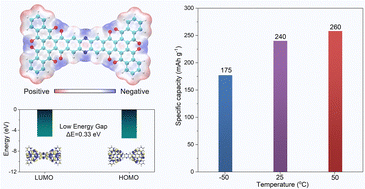
Organic materials are promising candidates as cathodes for high-performance aqueous Zn-ion batteries (AZIBs) owing to their high capacity, structural adjustability, and sustainability. However, their practical application is hindered by limited redox activity and low electronic conductivity under harsh operating conditions. Here, we report an organic polymer cathode prepared using a simple one-pot method, poly(mellitic trianhydride-phenazine) (PMPZ), featuring a fully conjugated structure and abundant active functional groups. The incorporation of heterocyclic conjugated units into the conjugated polymer structure enhances its electron affinity and π-electron delocalization, resulting in high redox activity and significantly elevated conductivity. Meanwhile, multiple C![[double bond, length as m-dash]](https://www.rsc.org/images/entities/char_e001.gif) O and CN redox-active centers act cooperatively to enable a multielectron redox process through this delocalization pathway, thereby improving charge storage and reaction kinetics. Through combined theoretical and operando synchrotron experimental studies, we further elucidate that this fully conjugated structure facilitates reversible Zn2+/H+ co-storage with multiple electron transfers. Consequently, the PMPZ cathode demonstrates exceptional electrochemical performance with remarkable rate capability and outstanding cycling stability across a wide temperature range from −50 °C to 50 °C, even with seawater-based electrolytes. This work provides a novel design strategy for developing high-performance AZIB cathodes capable of operating under extreme conditions.
O and CN redox-active centers act cooperatively to enable a multielectron redox process through this delocalization pathway, thereby improving charge storage and reaction kinetics. Through combined theoretical and operando synchrotron experimental studies, we further elucidate that this fully conjugated structure facilitates reversible Zn2+/H+ co-storage with multiple electron transfers. Consequently, the PMPZ cathode demonstrates exceptional electrochemical performance with remarkable rate capability and outstanding cycling stability across a wide temperature range from −50 °C to 50 °C, even with seawater-based electrolytes. This work provides a novel design strategy for developing high-performance AZIB cathodes capable of operating under extreme conditions.
- This article is part of the themed collections: Recent Open Access Articles and Energy & Environmental Science Recent HOT Articles
 Please wait while we load your content...


