


 PLATFORM UPDATE:


Integrating atomic scale catalyst design with transport engineering for stable and efficient CO2 electrolysis to CO in a membrane electrode assembly

Abstract
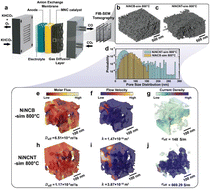
Electrochemical CO2 reduction (CO2R) offers a promising approach to for decarbonizing chemical manufacturing through production of carbon-neutral fuels. However, insufficient performance and instability of the membrane electrode assembly (MEA) reactors limit the commercial viability, with both metrics directly impacted by the CO2R catalysts. Here we develop atomically dispersed nickel–nitrogen–carbon (NiNC) catalysts through a scalable synthesis approach that enables controlled dispersion of isolated Ni active sites using two different carbon supports. When using carbon nanotubes as a support, the resulting NiNCNT electrode achieves a partial current density towards CO of 558 mA cm−2 with 92% faradaic efficiency towards CO at a cell voltage of 3.2 V and an energy efficiency of 39% at a total current density of 607 mA cm−2. The MEA demonstrated stable operation at 100 mA cm−2 over 210 hours, outperforming previously reported NiNC catalysts. Focused ion beam-scanning electron microscopy (FIB-SEM) tomography reveals the critical role of catalyst support architecture in governing electrode performance. COMSOL Multiphysics simulations using the 3D reconstructed images of the catalyst layers from FIB-SEM tomography demonstrated that the higher CO2R performance of the NiNCNT electrode is due to improved CO2 diffusion and a more uniform current-density distribution compared to the NiNCB electrode prepared with carbon black as the support. These results highlight the key role of catalyst-layer morphology in governing the CO2R performance of the two catalysts, despite their similar Ni and N loadings. The stability and performance of the NiNCNT compared favourably to the state-of-the-art Ag-based catalysts, while bottom-up cost analysis estimated the projected purchase cost of the NiNCNT catalyst to be $589 USD per kg, substantially lower than $1900 USD per kg estimated for Ag-based catalysts, highlighting its potential for scalable and economically viable CO2R electrolyzers.
 Please wait while we load your content...


