


 PLATFORM UPDATE:


Conformal hetero-electrolyte interface between soft oxyhalides and garnet enables low-pressure lithium-reservoir-free solid-state batteries
 †c
Vipin K.
Singh,
†a
Karthikeyen
Natarajan Pugazhendhi,
a
Pallab
Barai,
d
Cathy
Wang,
c
Jürgen
Janek,
b
Linda F.
Nazar
*a
†c
Vipin K.
Singh,
†a
Karthikeyen
Natarajan Pugazhendhi,
a
Pallab
Barai,
d
Cathy
Wang,
c
Jürgen
Janek,
b
Linda F.
Nazar
*a
Abstract
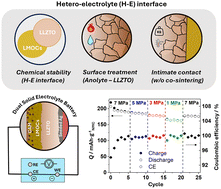
The operation of solid-state batteries with a lithium metal anode and a high voltage cathode requires solid electrolytes (SEs) that are chemically stable with lithium, have a wide electrochemical window, and accommodate volume changes in the electrodes. Unfortunately, no SE has exhibited satisfactory mechanical and electrochemical properties that fit these requirements to date. Dual solid electrolyte systems that use a different SE for the anolyte and catholyte present a viable solution. Here, we focus on oxyhalide SEs that demonstrate superior ionic conductivity and cathode compatibility, where their lithium metal reactivity and poor reduction stability can be resolved using a lithium garnet (Li6.5La3Zr1.5Ta0.5O12, LLZTO) separator. Nonetheless, this imposes a new hetero-electrolyte (H-E) interface at the anolyte|catholyte contact that defines the ion transport across the boundary. We report its promising properties, which are deconvoluted from the electrical measurements of bilayer symmetric cells, for three representative oxyhalide catholytes, LiNbOCl4, LiTaOCl4, and Li3Al3O2Cl8. Pressure-dependent measurements reveal that the relative softness of the oxyhalides (hardness ≤0.4 GPa) enables H-E resistances lower than 150 Ω cm2 at 2–3 MPa. Mesoscale modelling reveals that the transfer-active contact area of oxyhalides with LLZTO is about 2–3-fold higher than that of argyrodite, Li6PS5Cl. The low H-E resistance of the LiNbOCl4|Li6.5La3Zr1.5Ta0.5O12 dual electrolyte enables the cycling of a Li|LiNi0.82Mn0.07Co0.11O2 full cell with a high discharge capacity (200 mA h g−1) at 60 °C and ∼7 MPa. Importantly, we demonstrate a Li-reservoir-free full cell with high Coulombic efficiency (>99.5%) and capacity at 1 MPa using this approach coupled with a garnet-silver interlayer.
- This article is part of the themed collection: Recent Open Access Articles
 Please wait while we load your content...


