


 PLATFORM UPDATE:


Reticular frameworks in dielectric polymer composites: a platform for electrostatic energy storage

Abstract
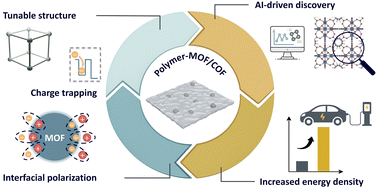
The pursuit of high-performance polymer-based dielectric composites is critical for advanced electrostatic energy storage applications, demanding the simultaneous realization of high energy density, thermal stability, and rapid charge–discharge capability. Reticular framework materials, represented by metal–organic frameworks (MOFs) and covalent organic frameworks (COFs), have recently emerged as transformative fillers owing to their modular architectures and tunable electronic structures. Unlike conventional inorganic fillers, MOFs and COFs enable precise energy-level alignment, deep trap formation, and strong interfacial interactions with polymer matrices, thereby effectively suppressing charge transport, mitigating dielectric loss, and enhancing breakdown strength. Furthermore, the controllable dimensionality and morphology of reticular frameworks allow tailored percolation thresholds, mechanical reinforcement, and optimized polarization. Through the integration of interfacial engineering with reticular design, polymer–framework composites have exhibited exceptional discharged energy densities, particularly at elevated temperatures. Looking forward, the convergence of reticular chemistry, hierarchical interface design, and AI-guided discovery promises a rational platform for the predictive synthesis of next-generation dielectric composites, enabling unprecedented control over dielectric behavior, energy storage performance, and multifunctional properties. This minireview highlights the fundamental charge behaviors, interface-mediated transport mechanisms, and key design principles underpinning polymer–MOF/COF composites, providing a roadmap for the development of high-efficiency, high-performance electrostatic energy storage materials.
- This article is part of the themed collection: Energy & Environmental Science 2026 Review Articles
 Please wait while we load your content...


