


 PLATFORM UPDATE:


Breaking the efficiency bottleneck of inverted organic solar cells by reversed sequential deposition
 *b
Hai-Qiao
Wang
*a
and
*b
Hai-Qiao
Wang
*a
and
Abstract
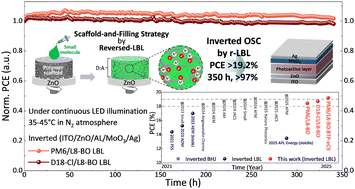
Inverted organic solar cells (OSCs) are recognized for their superior operational stability, yet their efficiency, when fabricated via the layer-by-layer (LBL) approach, has remained substantially behind that of conventional architectures. This limitation stems from the inherent dissolution of the initial small-molecule acceptor (SMA) layer during sequential deposition and a fundamental misalignment between the resultant vertical component distribution and the optical field. Here, we introduce a reversed LBL (r-LBL) strategy, which inverts the conventional deposition sequence. We first construct a robust polymer donor (PD) scaffold, followed by the interstitial infiltration of SMA solutions. This order strategically positions the donor at the transparent electrode side, aligning its distribution with the light intensity maximum for optimal photon harvesting. Concurrently, it prevents the dissolution of the initial layer. The resulting active layer exhibits an ideal “polymer-scaffold-with-SMA-filling” morphology, characterized by enhanced crystallinity and face-on molecular orientation. This leads to inverted OSCs with remarkable power conversion efficiencies (PCEs) of 18.44% (PM6/L8-BO), 18.71% (D18-CI/L8-BO), and 19.20% (PM6/L8-BO:BTP-eC9). These devices also demonstrate exceptional operational stability, retaining over 97% of their initial PCE after 340 hours of continuous illumination. The universality of this r-LBL strategy is further validated in small-molecule-donor:polymer-acceptor systems, establishing it as a foundational and universal processing principle to overcome the efficiency-stability trade-off in inverted OSCs.
 Please wait while we load your content...


