


 PLATFORM UPDATE:


Safeguarding drinking water in north-western europe by modelling the fate of amines from CO2 capture
 *ab
*ab
Abstract
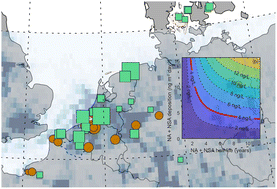
The European Union (EU) net-zero emission target for 2050 requires large-scale deployment of carbon capture and storage (CCS). Amine-based CO2 capture (CC) is the most mature CC technology but may lead to the spread of nitrosamines (NSAs) and nitramines (NAs) in the nearby surroundings. These are carcinogenic compounds that can persist in water resources. Hence, EU's ambition towards carbon neutrality might pose risk of drinking water contamination as well as ecosystem and agricultural crops pollution. We compiled a dataset of planned CCS projects in the Franco-Danish corridor, Europe's future CCS hub, where most capacity will be located by 2030, with at least 40% based on amine technology. Spatial analysis indicates that up to 10.2 million inhabitants, large Natura 2000 reserves, and extensive crop areas may be impacted by NA and NSA deposition, often in regions already under severe water stress. Biogeochemical modelling shows that surface waters with short residence times are highly sensitive to deposition rates, whereas groundwater concentrations depend strongly on the interplay between NA and NSA half-lives and travel times, creating greater uncertainty in aquifers, especially small systems with limited dilution. In both cases, MEA is the most environmentally friendly when emission abatement measures are limited to water wash, compared to piperazine and other emerging solvents. Main findings highlight the need for regional-scale modelling and harmonized regulation to safeguard drinking water, ecosystems, and food security as CCS deployment expands.
- This article is part of the themed collection: Recent Open Access Articles
 Please wait while we load your content...


