


 PLATFORM UPDATE:


Ligand-field regulation enables high energy-efficiency cathodes for aqueous zinc-ion batteries

Abstract
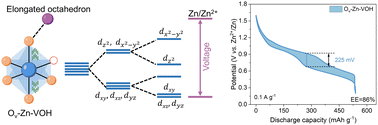
Aqueous zinc-ion batteries (ZIBs) are promising candidates for large-scale energy storage owing to their high safety, low cost, and environmental friendliness. However, the practical application of ZIBs remains challenging due to their low energy density and energy efficiency owing to their rapid capacity fading and voltage decay, large voltage polarization, and sluggish reaction kinetics. In this work, we introduce a ligand-field engineering strategy that couples pre-intercalated ion interaction with octahedral defects to inhibit energy loss in layered hydrated vanadium pentoxide (V2O5·nH2O, VOH) cathodes. Comprehensive experimental analyses reveal that the introduction of pre-intercalated ions and oxygen vacancies induces [VO6] octahedral distortion and V–O bond elongation, thereby tailoring the ligand field and lowering the V 3d orbital energy level. This structure modulation effectively narrows the voltage hysteresis, stabilizes the voltage plateau and enhances the energy efficiency. In addition, this ligand-engineering strategy for enhancing energy efficiency can be extended to low-temperature conditions and other similar systems. As a result, the Ov-Zn-VOH cathode delivers a high discharge capacity (536 mAh g−1 at 0.1 A g−1) coupled with high energy efficiency (86%) and an energy efficiency retention of 94% after 3000 cycles at 4 A g−1.
 Please wait while we load your content...


