


 PLATFORM UPDATE:


Replicability challenges in redox flow cell testing: insights from a multi-institutional study
 a
Alexander H.
Quinn,
b
Edward
Saunders,
cd
Thomas R.
Goodwin,
b
Nadia L.
Farag,
c
Greta
Thompson,
cd
Thomas Y.
George,
h
Jordan D.
Sosa,
h
Carlos J.
Mingoes,
i
Peter
Nockemann,
a
Clare P.
Grey,
c
Dominic S.
Wright,
c
Michaël
De Volder,
d
Antoni
Forner-Cuenca,
e
Robert A. W.
Dryfe,
fg
Michael J.
Aziz,
h
Ana B.
Jorge Sobrido,
i
Fikile R.
Brushett
b
and
Josh J.
Bailey
*a
a
Alexander H.
Quinn,
b
Edward
Saunders,
cd
Thomas R.
Goodwin,
b
Nadia L.
Farag,
c
Greta
Thompson,
cd
Thomas Y.
George,
h
Jordan D.
Sosa,
h
Carlos J.
Mingoes,
i
Peter
Nockemann,
a
Clare P.
Grey,
c
Dominic S.
Wright,
c
Michaël
De Volder,
d
Antoni
Forner-Cuenca,
e
Robert A. W.
Dryfe,
fg
Michael J.
Aziz,
h
Ana B.
Jorge Sobrido,
i
Fikile R.
Brushett
b
and
Josh J.
Bailey
*a
Abstract
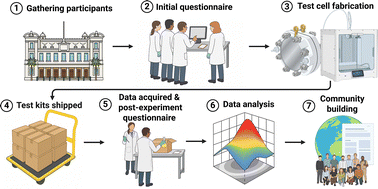
Flow battery research is growing at pace, given the global need for longer-duration energy storage technologies. Positioned at the intersection of several scientific and engineering disciplines, flow battery studies involve significant experimental complexity that serves as a source of variability when assessing performance. Experimental errors arise from variable flow-cell assembly practices, discrepancies in electrochemical technique protocols, inhomogeneous material properties, or uncontrolled environmental conditions—all influencing the metrics reported across laboratories. Nonetheless, the magnitude of this variability in performance indicators from typical electrochemical techniques is rarely assessed. This lack of replicability testing presents challenges for interlaboratory comparison, reducing research confidence in performance ascription. We therefore performed a round-robin study involving eight participant groups (seven academic institutions) on a model flow cell system, comprising a well-studied electrolyte, in a symmetric flow-cell configuration. Despite identical cell hardware, electrolyte chemistry, and experimental prompts, appreciable differences were observed in the charge–discharge profiles, polarisation curves, and Nyquist plots resulting from participant data acquisition. The study identifies that protocol and/or in-batch material differences have clear and non-negligible effects on reported performance metrics and provides an indication of the magnitude of variabilities that can be observed for a single system. Athough definitive attribution may require a larger number of participants, several plausible sources of variability were identified, and targeted follow-up testing was undertaken at the coordinating institutions to inform protocol refinement. Both electrical connections and electrolyte homogeneity in the reservoirs were observed to be non-negligible sources of variability in ohmic resistance and electrolyte utilisation, respectively. Overall, the data and insights from this well-controlled, single-electrolyte system highlight the need for greater methodological transparency, shared protocols, and standard operating procedures to reduce significant replicability error in systems of interest. Additionally, the methodology presented may guide further multi-institutional studies to address sources of variance across systems and chemistries.
- This article is part of the themed collection: Recent Open Access Articles
 Please wait while we load your content...


