


 PLATFORM UPDATE:


Deprotonated self-assembled molecules as robust hole-selective layers for perovskite/organic tandem solar cells and photocathodes
 †a
Jongdeuk
Seo,
a
Han Young
Woo,
c
Shinuk
Cho,
b
Dong Suk
Kim,
*ad
Jin Young
Kim
*ad
†a
Jongdeuk
Seo,
a
Han Young
Woo,
c
Shinuk
Cho,
b
Dong Suk
Kim,
*ad
Jin Young
Kim
*ad
Abstract
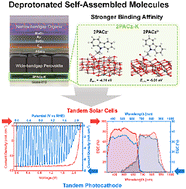
Self-assembled monolayer (SAM)-based hole-selective layers (HSLs) offer a promising route to defect-passivated and energy-aligned interfaces in perovskite organic tandem solar cells (POTSCs). However, their practical implementation remains hindered by weak anchoring to transparent conductive oxides (TCOs), leading to desorption during perovskite deposition and poor interfacial durability under polar solvent exposure. Here, we present a chemical interfacial stabilization strategy in which potassium carbonate (K2CO3) mediates the controlled deprotonation of [2-(9H-carbazol-9-yl)ethyl]phosphonic acid (2PACz), forming mixed mono- and di-deprotonated species (2PACz-K) that bind strongly to indium tin oxide (ITO). The resulting SAM exhibits superior solvent resistance, improved energy-level alignment, and enhanced buried interface quality. POTSCs incorporating 2PACz-K achieve 25.10% power conversion efficiency (PCE) with a high open-circuit voltage (VOC) of 2.230 V, while retaining 80% of their initial PCE after 220 h of maximum power point (MPP) tracking under simulated 1-sun illumination. Beyond photovoltaics, the robust 2PACz-K interface is further integrated into a perovskite/organic tandem photocathode (POT-PEC), representing the first transparent, metal-free tandem PEC architecture capable of stable operation in aqueous electrolyte, delivering a photovoltage (Vph) of 2.16 V and achieving a solar-to-hydrogen (STH) conversion efficiency of 7.7%. This work establishes a versatile interfacial design paradigm that bridges photovoltaic and photoelectrochemical energy conversion.
- This article is part of the themed collections: Celebrating Nam-Gyu Park’s 65th birthday, Recent Open Access Articles and Power-to-X and Solar-to-X Technologies for a Net-Zero Future
 Please wait while we load your content...


