


 PLATFORM UPDATE:


Interfacial engineering principles for hard carbon anodes in sodium-ion batteries: from mechanisms to synergistic strategies
 *a
and
Jun
Liu
*b
*a
and
Jun
Liu
*b
Abstract
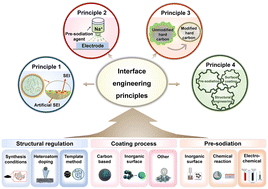
Sodium-ion batteries (SIBs) have attracted considerable attention for large-scale energy storage owing to their low cost, high safety, and resource abundance. Among various anode materials, hard carbon stands out for its high capacity and low operating voltage. However, its practical application is severely limited by its interfacial instability, manifested as a low initial coulombic efficiency (ICE) and poor cycling stability. Recognizing interfacial instability as the key bottleneck in the commercialization of hard carbon anodes, this review constructs a three-pillar framework that comprises structural modulation, surface coating, and presodiation and proposes a synergistic design paradigm to systematically tackle these challenges. It reveals the mechanisms by which interfacial engineering suppresses side reactions, guides the formation of the solid electrolyte interphase (SEI) film, and compensates for initial sodium loss. This review provides an in-depth analysis of interfacial failure processes and structure–function relationships in SEI film regulation. It also highlights SEI film characterization techniques as essential tools for understanding interfacial reaction mechanisms and validating the effectiveness of interfacial engineering strategies. Building on these insights, this review distills core interfacial design principles for achieving high-ICE and long-life hard carbon anodes and offers a clear roadmap for the rational design of high-performance hard carbon electrodes and the commercialization of SIBs.
- This article is part of the themed collection: Energy & Environmental Science 2026 Review Articles
 Please wait while we load your content...


