Electrical power generation from asymmetric greenhouse gas capture

Abstract

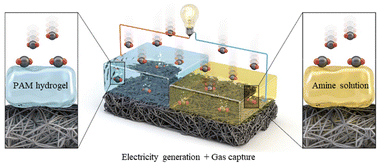
Capturing greenhouse gases (GHGs) while generating electricity offers a new paradigm for climate mitigation. Here, we report a GHG-driven energy harvesting system, termed a gas capture and electricity generator (GCEG), that directly converts the adsorption of NOx and CO2 into electrical power. The device integrates a carbon black-coated mulberry paper electrode with an asymmetrically dip-coated polyacrylamide hydrogel, enabling selective gas adsorption and voltage generation via modulation of the electrical double layer. Upon exposure to 50 ppm NO2, the GCEG delivers 0.8 V and 55 µA, scaling to 3.8 V and 140 µA through series and parallel integration. Infrared spectroscopy and atomistic simulations reveal that hydrogen-bond-driven gas–hydrogel interactions govern the energy harvesting mechanism. By integrating gas capture and electricity generation within a single self-powered platform, this approach provides a scalable, low-energy pathway for mitigating multiple GHGs and offers a promising strategy toward carbon neutrality.
Supplementary files

Transparent peer review

To support increased transparency, we offer authors the option to publish the peer review history alongside their article.

View this article’s peer review history

Article information

Article type
Paper
Submitted
09 Nov 2025
Accepted
13 Feb 2026
First published
13 Feb 2026
This article is Open Access
Creative Commons BY-NC license

Energy Environ. Sci., 2026, Accepted Manuscript

Electrical power generation from asymmetric greenhouse gas capture

T. Yun, Y. Lee, J. Shin, D. H. Lee, M. T. Hong, S. Lee, S. Kim, H. J. Lee, J. Lee, G. Min, S. Weon, M. Choi, H. W. Jang, H. S. Kim and J. Jang, Energy Environ. Sci., 2026, Accepted Manuscript , DOI: 10.1039/D5EE06789H

This article is licensed under a Creative Commons Attribution-NonCommercial 3.0 Unported Licence. You can use material from this article in other publications, without requesting further permission from the RSC, provided that the correct acknowledgement is given and it is not used for commercial purposes.

To request permission to reproduce material from this article in a commercial publication, please go to the Copyright Clearance Center request page.

If you are an author contributing to an RSC publication, you do not need to request permission provided correct acknowledgement is given.

If you are the author of this article, you do not need to request permission to reproduce figures and diagrams provided correct acknowledgement is given. If you want to reproduce the whole article in a third-party commercial publication (excluding your thesis/dissertation for which permission is not required) please go to the Copyright Clearance Center request page.

Read more about how to correctly acknowledge RSC content.

Social activity

Spotlight

Advertisements