


 PLATFORM UPDATE:


Superbasic CO2-concentrating layer-protected nickel catalyst for solar CH4 synthesis via direct air capture
 a
and
Yingxuan
Li
*a
a
and
Yingxuan
Li
*a
Abstract
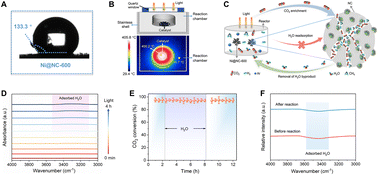
Although direct air capture technology shows promise for atmospheric CO2 reduction, it is hindered by the energy-intensive CO2 concentration processes and unresolved long-term storage risks. As an alternative approach, direct conversion of atmospheric CO2 into solar fuels could simultaneously achieve carbon neutrality and energy storage, yet existing conversion technologies predominantly require high-concentration CO2 streams. Herein, we demonstrate a nickel-encapsulated mesoporous nitrogen-doped carbon (NC) architecture that enables integrated CO2 capture from air and CH4 production via in situ catalysis of the captured CO2 with H2 under solar irradiation. The engineered mesoporous NC framework with superbasic sites achieves exceptional CO2 capture capacity (55 cm3 g−1) and ultrafast adsorption–desorption kinetics (equilibrium attained in ∼1 min) under ambient conditions. The Ni nanoparticles and NC layers function as tandem catalytic sites for CH4 production, where photogenerated electrons drive H2 dissociation on Ni sites, while the adsorbed CO2 on NC undergoes photothermal reduction to CH4 by the spilled hydrogen. This mechanism enables a record CH4 production rate of 339 mmol g−1 h−1 (nearly identical with that obtained using pure CO2), with perfect selectivity through atmospheric CO2 conversion. Furthermore, the hydrophobic NC overlayers effectively prevent Ni sintering via physical confinement effects and inhibit oxidative deactivation by dynamically scavenging the H2O byproduct, enabling the catalyst to maintain stability for over 100 cycles of atmospheric CO2 capture and conversion. Our temporal-decoupling strategy for converting atmospheric CO2 eliminates oxygen interference in ambient air and energy-intensive concentration steps, thereby establishing an innovative paradigm for producing carbon-neutral fuels.
 Please wait while we load your content...


